Key Icomera Solutions


The Background
The GZ-30 research project was co-funded by Germany’s Federal Ministry of Transport and Digital Infrastructure (BMDV) through its Innovative Netztechnologien (InnoNT) Programme.
The tests took place on high-speed lines across Germany, evaluating important parameters such as total network throughput, coverage, latency, and connection stability over the entire route.
The Technology
Satellite x Cellular Antennas: High-Capacity Aggregated Connectivity
The GZ-30 trial provided a means of demonstrating the viability of Low Earth Orbit (LEO) satellite constellations to reach gigabit connectivity on high-speed rail vehicles.
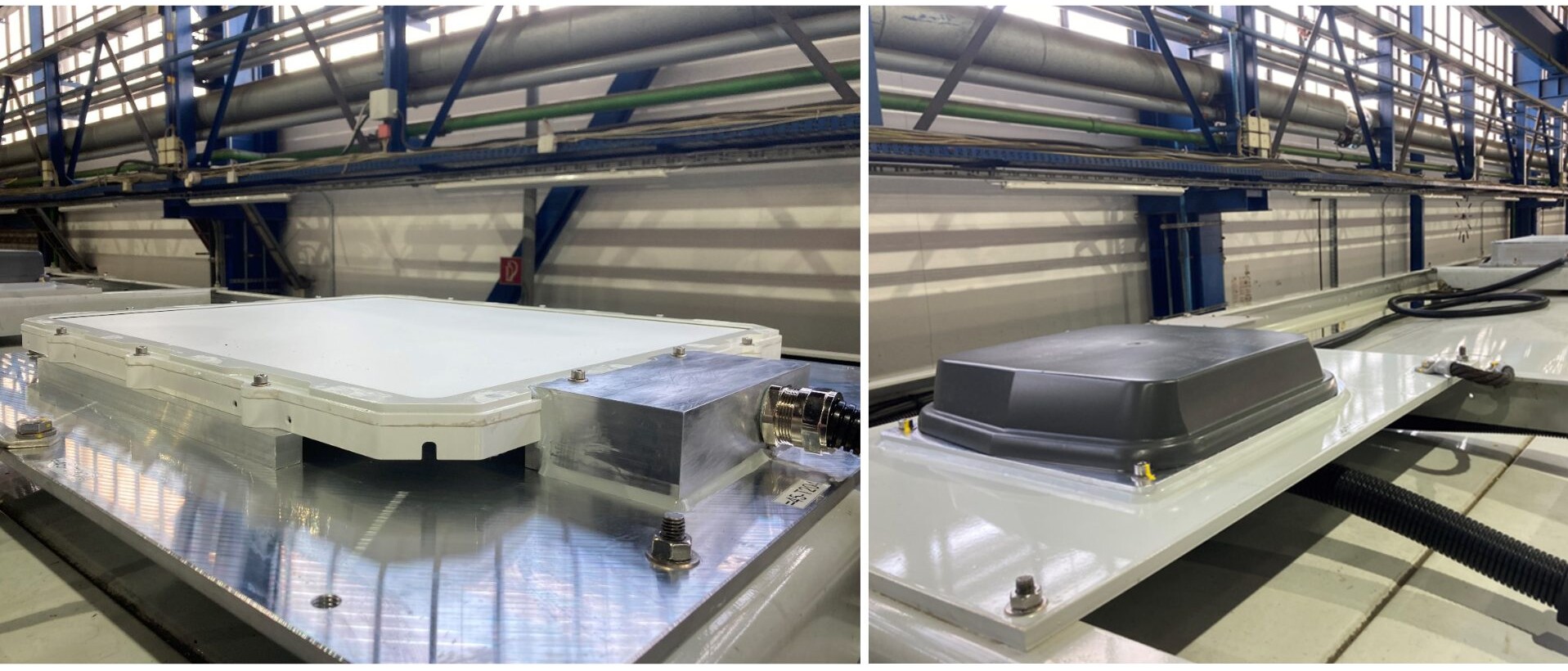
Icomera and Deutsche Bahn installed 2 Starlink satellite antenna tiles onto the vehicle and seamlessly aggregated satellite and cellular communication links using its SureWAN™ algorithm, supporting the hardware using its ICONIC network monitoring software suite.
Low Earth Orbit Satellite Connectivity: The Sky’s (No Longer) the Limit
As an authorised reseller of Starlink for rail, Icomera demonstrated how its satellite connectivity solution for trains can enhance transport operators’ digital strategies by integrating high-throughput, low-latency satellite Internet connectivity with its robust onboard network platform.
Sectorised Antennas
Omni-directional antennas have historically been a mainstay for public transport connectivity solutions due to their simplicity and broad coverage. However, their all-encompassing design often yields interference, reduced signal quality, and limited throughput, particularly when multiple frequency bands or networks vie for bandwidth at the same time.
For the trial, Icomera deployed sectorised antenna technology, which resolve these challenges by dividing the coverage area into discrete segments or “sectors,” each optimised to track signals from a particular direction or frequency band.
Icomera X7: Scalable, Future-Proof Connectivity for Rail
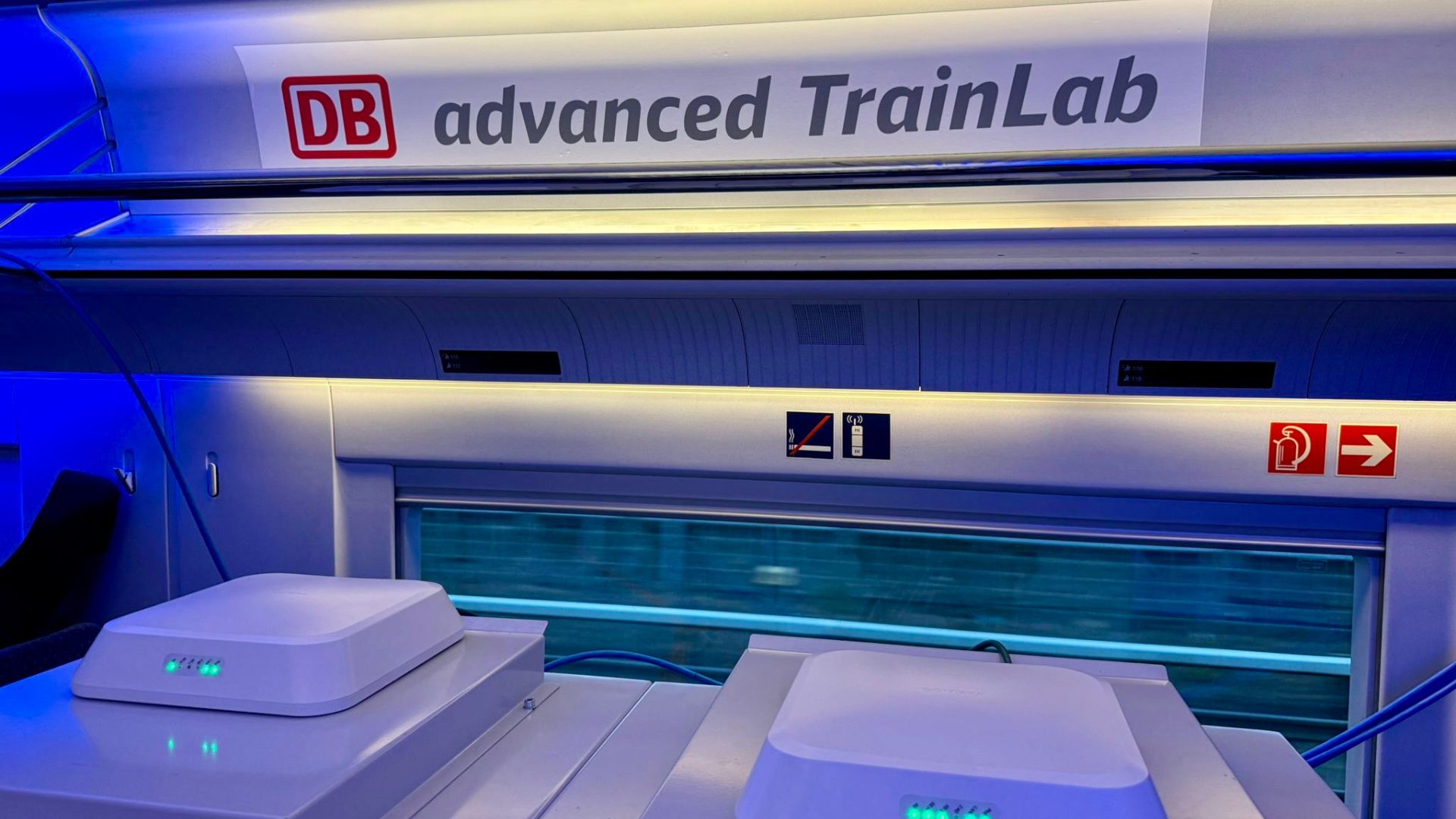
At the heart of the Gigabit Zug network was the X7: Icomera’s flagship high-performance mobile connectivity and applications hosting platform, purpose-built for public transport. It unifies future-proof aggregated connectivity, secure virtualised application hosting, and robust built-in storage to satisfy even the most demanding requirements.
The onboard gateway utilised SureWAN™, Icomera’s industry-leading connectivity technology protocol for combining multiple networks (cellular, satellite, trackside) in parallel, providing the fastest, most reliable connection available for onboard systems.
Wi-Fi 7 Access Points: Harnessing the Latest Wireless Standard
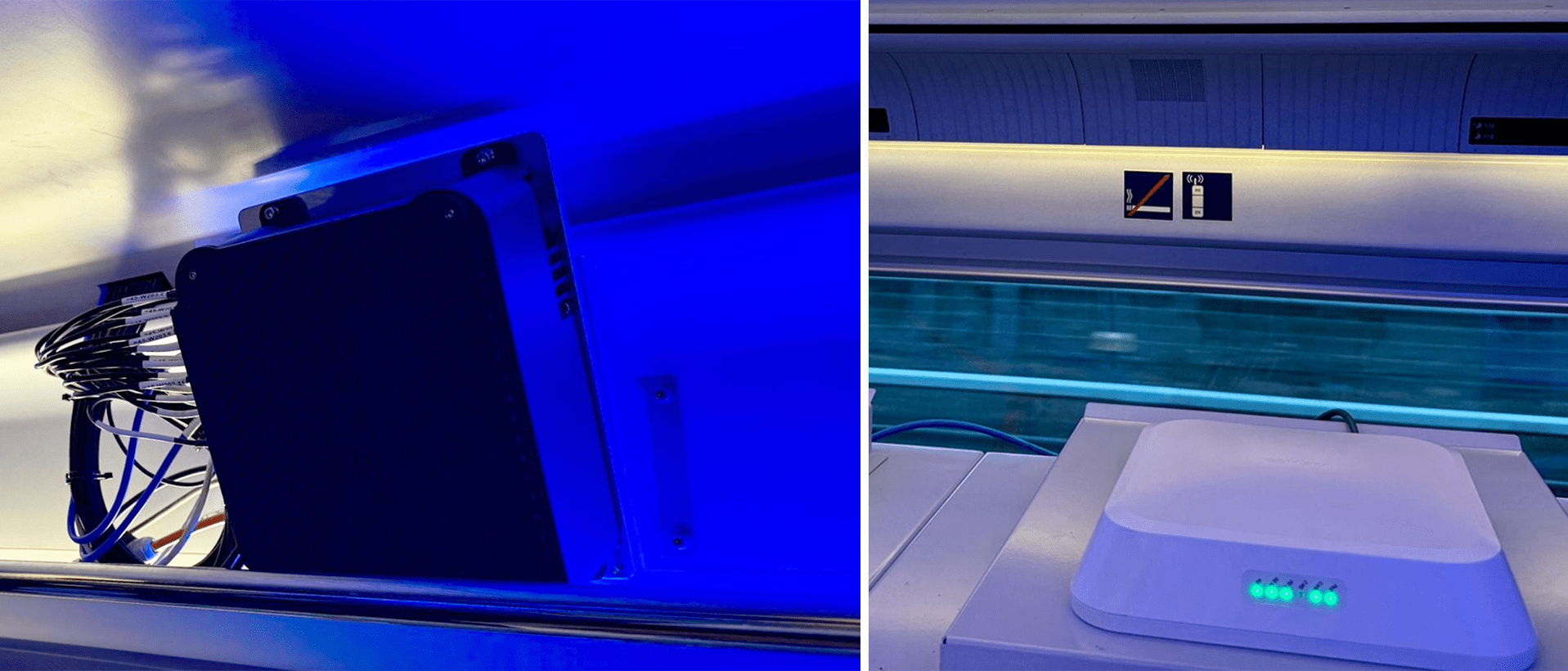
An onboard network is only as powerful as its weakest point. Icomera’s A2 Wi-Fi 7 Access Points enhance stability and prevent bottlenecks using wider channels and multi-link technology, while leveraging Wi-Fi 7 (the latest standard in wireless connectivity), ensuring that connected onboard devices receive maximum throughput, even in congested conditions.
- Higher Data Rates: Wi-Fi 7’s improved channel bandwidth (up to 320 MHz) enables gigabit data throughput on each AP.
- Reduced Congestion: Multi-link capabilities help distribute traffic more effectively, so that real-time services (video calls, conferencing) experience minimal jitter or delay.
- Optimised Performance: Advanced modulation techniques, such as 4K-QAM, further improve spectral efficiency, ensuring that each connection is utilised to its maximum potential.
The Results
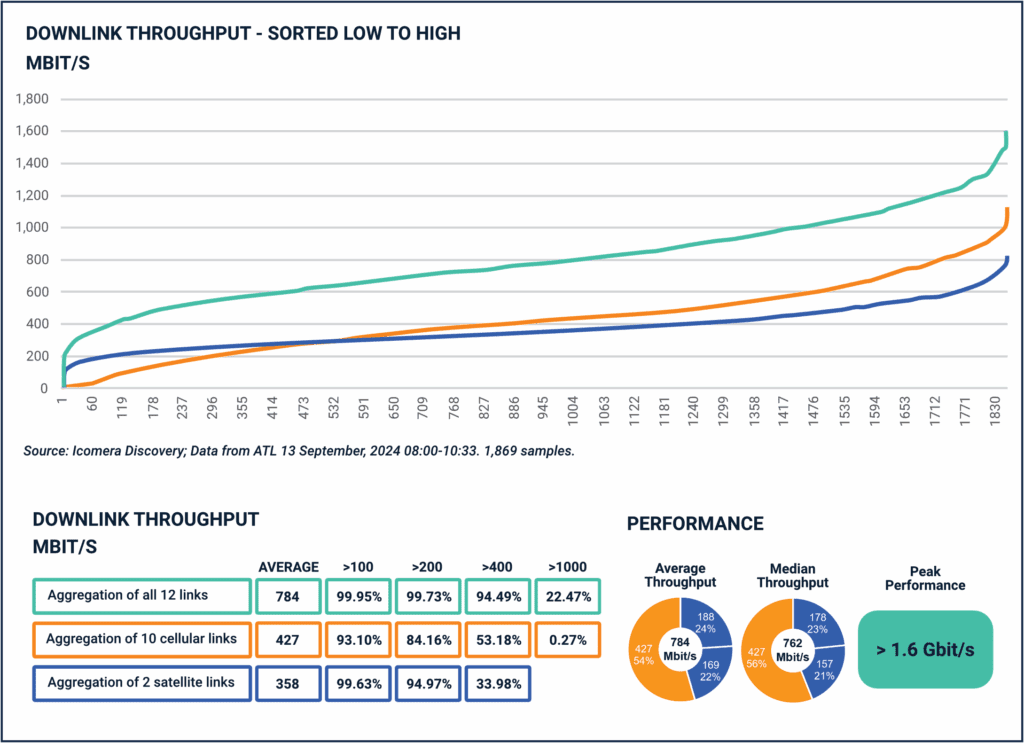
The results of the trial were impressive. Icomera demonstrated consistent availability and high throughput for the duration of the test. An average throughput of 784 Mbit/s was reached, along with a peak of 1.6 Gbit/s, delivering an exceptional level of capacity for onboard devices, systems, and passengers.
- 2 satellite antennas reached an average throughput of 188 Mbit/s and 169 Mbit/s, respectively, nearly as much throughput as 10 cellular links.
- Sectorised antennas outperformed omnidirectional antennas on average, handling numerous concurrent user sessions while maintaining robust, low-latency connections.
- Tests spanned 7 weeks across a total of 15,000 km (around 9,320 miles).
- 40 Terabytes of data were transferred via 5G networks.
- The total data volume equated to around 20,000 hours of HD video, or about 10 million high-resolution photos.
Related Reading

NEWS
Icomera and SpaceX Starlink to Transform Onboard Rail Connectivity
14 November 2024
Empowering rail networks with ingenious satellite technology to deliver uninterrupted connectivity. Benefits for passengers and operators, enhancing both Wi-Fi services and intelligent operational systems....
Read more
NEWS
WI-FI on Trains: How Does It Work and Why It Matters?
22 April 2025
Have you ever wondered, “How does wifi on trains work?” or perhaps, “Can you get WiFi on trains reliably?” With hybrid working becoming the...
Read more